Posts

Showing posts with the label astrophotography

Adventures in Astrophotography Post-Processing

Image
 These days I do most of my blog-type posting on aus.social, a Mastodon instance. Sometimes though the limited formatting makes that a poor choice. This is one such case. Today I want to take you through the post-processing steps I go through to create a final astrophotographic artwork. And these are artworks, not scientific records. I could  use the same data to perform astrometric observations, but I don't. I like to create beautiful images. Knowing the things I am creating pictures of is part of creating that beauty, and that does require some scientific knowledge, but it is only a means to an end.  So, let's start with what comes out of my telescope. I use either a DwarfII or Dwarf3 smart telescope for my imaging, and what comes out of that is already pre-processed in a variety of ways. The telescope does its own stacking, and has a built-in link to a cloud post processor. So what I get is two images - one denoised and with basic image optimisations performed, and ano...

NYE 2024 Star Party

Image
On the night of New Year's Eve 2024 we (myself, Leece , and her mum) saw in the New Year by hosting a star party for family and friends. To make it as accessible as possible, we found a park in Como that is almost completely dark, despite being only a couple of kilometres from the CBD. Adjacent to this park is the Como Croquet Club, so we hired their clubhouse as a base of operations. Two days before, we got a panicked message from the club, asking if their members could have a gathering of their own - which was fine with us, as long as they did not want to turn on the field lights. So we had twenty odd people turn up, along with about the same number of Croquet Club members. As it turns out, the son of one of my workmates played in high school, and got his family into playing a game, much to the delight of the club members. Sun by Rob We started proceedings with a couple of shots of the sun and the current sunspots (Me: "This is what it looks like right now!" 16yo daught...

Gravity Discovery Centre Observatory Tour

Image
Last night we visited the Gravity Discovery Centre and Observatory in Gingin for one of their Observatory Tour nights. You get a full access ticket to the discovery Centre as a part of the tour ticket, so we made use of that to have a look around at the exhibits. The whole thing is a bit like a very focused SciTech or Powerhouse Museum sort of idea. The GDC at sunset, the Leaning Tower to the right, and the Lecture Dome and Giant Pendulum to the left We also collected the five solargraph cameras that we set up six months ago. Three of these were Solarcan Pucks, and two were home-brew can cameras. One of the Pucks was, alas, full of water, and the film was washed away. One of the can cameras was also heavily water filled, while the other had been partially crushed. The other two Pucks were in perfect condition. Six month solargraph of the giant pendulum, with the Leaning Tower in the background. What was unexpected was that both can cameras had acquired significant populations of tiny...

Post processing in Astrophotography - comparing images

Image
 I am a novice when it comes to driving advanced post-processing tools like Siril , which, if you are getting into astrophotography, I highly recommend. It does have a steep learning curve, especially the post-stack processing side. Powerful, but not intuitive. But if you want quick results from your funky new smart telescope, you do have alternatives. So let's have a look at some solar photography and see what happens. Here is a untouched image, and the same image with some in-camera curve adjustment. The only edit is to crop the image. The Sun, unmodified With in-camera curve  adjustment Straight away, you can see more detail - the penumbras are clearer in sun spots, the granulation is more obvious.  Now let's look at what happens when you get heavy handed with Snapseed's structure and sharpening tools, adjusting the shadows and highlights a bit more, adding a touch of HDR and tweaking the colour balance. Heavily post processed in Snapseed First up, the granulation is v...

Hunting Neptune

Image
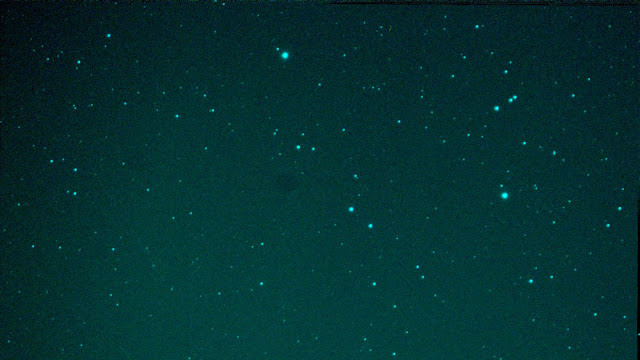
  Back in the day, and I mean starting around the turn of last century, you'd hunt for planets by taking photos through your telescope days or weeks apart, and then comparing the two plates.  Today I proved to myself that I have photographed Neptune from my front garden. This evening, I took this shot with my DwarfII - 10x15s exposures, stacked, and filtered to make everything cyan. In theory, somewhere in this image is Neptune. Good luck working out where. Cyan tinted star scape. Somewhere, Neptune is lurking. Last week, I did the same thing, but I tinted this one yellow. Yellow star scape. Neptune still hiding. Next, I composited them in Snapseed, and played with the opacity slider. Can you see Neptune now? Here are the two locations highlighted Neptune in two locations, circled Two very cool things about this. One, I did this with a telescope the size of a 1L UHT carton from my garden in the middle of suburbia! Two, it clearly shows how planets got their name - from the Gre...

Summing Up What Sort of Photography I Do!

Image
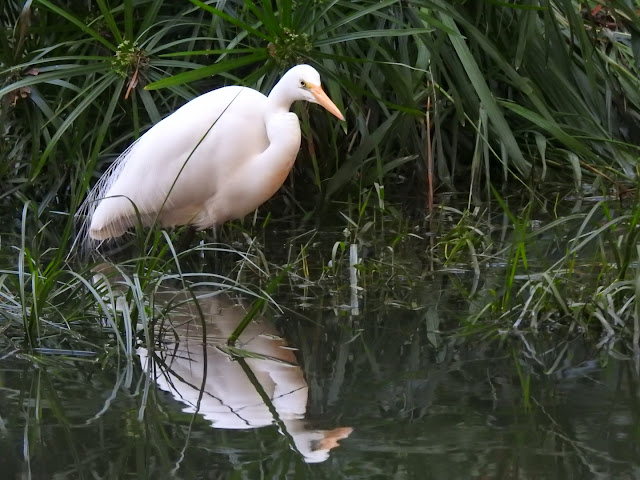
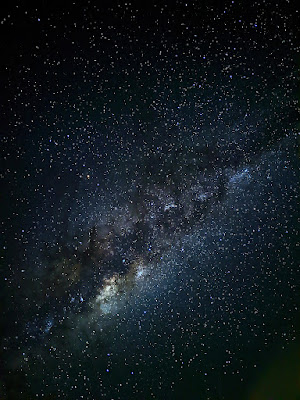
 Folks may have noticed that very little of my photography these days is "normal".  I do still take conventional photos with a fairly ordinary digital camera, but that is mostly my nature photography, and I do not often talk about that.  Great Egret - Herdsman Lake, June 2023. Nikon P900 I also do some astrophotography, up until recently using my mobile phone,  Milky Way, Pixel 6a, Guilderton, June 2022. but more recently with a Dwarf II 'smart telescope'.  Cat's Paw Nebula, Doubleview, June 2023, 98 x 15s frames, stacked in camera. These are not so much telescopes as dedicated astrophotography rigs controlled via a mobile app, and the results speak for themselves. They can align and stack multiple frames all by themselves, and compensate for significant levels of light pollution.  At the other extreme, I also experiment with in-camera cyanotype photography, using an 1830s era chemistry that is best known for making blueprints!  Mandurah Canal House, D...

Easy and cheap(ish) Astrophotography

Image
Astrophotography is arguably the most technically demanding discipline in the art of photography, with high demands in both equipment and post-processing. In recent years advances in mobile phone technology have given everyone access to easy wide-field astrophotography, leaving three areas that still require high end equipment: Stellar, Planetary, and Deep-sky.  Is there still a place for high end equipment in wide-field? Absolutely! Just like the Instagram folks are discovering that a real camera takes better photos than a mobile phone, so too will a dedicated astro rig take better photos than a mobile phone.  But the mobile is accessible, cheap, and easy to use - so it will get folks in.  If you can get shots like this in a Bortle 5 area, it will get you excited, and some folks will be inspired enough to go further.  But what about deep sky? Enter the "Smart Telescope".  These are not so much telescopes as dedicated astrophotography rigs. These have many advan...

More playing with the live composite mode of the TG-4. Edited with Snapseed​​

Image
More playing with the live composite mode of the TG-4. Edited with Snapseed​​ #perth #astrophotography #startrails #snapseed Next time, take the ND filters with me and the filter adaptor, so I can dim the city a little.