Posts

Showing posts with the label Space

Hunting Neptune

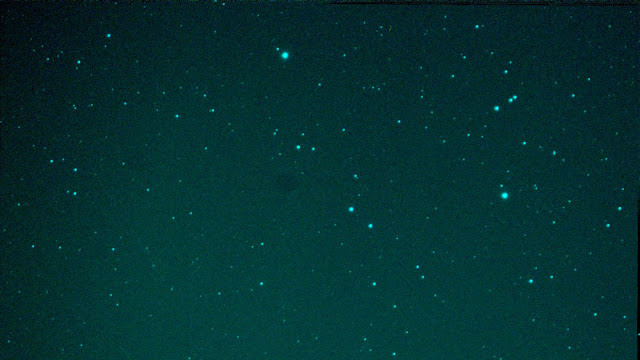
Image
  Back in the day, and I mean starting around the turn of last century, you'd hunt for planets by taking photos through your telescope days or weeks apart, and then comparing the two plates.  Today I proved to myself that I have photographed Neptune from my front garden. This evening, I took this shot with my DwarfII - 10x15s exposures, stacked, and filtered to make everything cyan. In theory, somewhere in this image is Neptune. Good luck working out where. Cyan tinted star scape. Somewhere, Neptune is lurking. Last week, I did the same thing, but I tinted this one yellow. Yellow star scape. Neptune still hiding. Next, I composited them in Snapseed, and played with the opacity slider. Can you see Neptune now? Here are the two locations highlighted Neptune in two locations, circled Two very cool things about this. One, I did this with a telescope the size of a 1L UHT carton from my garden in the middle of suburbia! Two, it clearly shows how planets got their name - from the Gre...

Will this lander avoid the Martian Space Defence Cannons?

Will this lander avoid the Martian Space Defence Cannons? Originally shared by Jaana Nyström On November 26th, a mole will land on Mars - The Oatmeal 👍🏻 See more: http://bit.ly/2S4a7Dh #Space #Mars #InSight #InSightWatchParty #Nasa #Science #CyberMonday http://bit.ly/2S4a7Dh

How dark is your sky? How far do you have to travel to reach a dark sky?

Image
How dark is your sky? How far do you have to travel to reach a dark sky? Originally shared by Friends of NASA The New World Atlas of Artificial Sky Brightness How far are you from a naturally dark night sky? In increasing steps, this world map (medium | large) shows the effect of artificial night sky brightness on the visual appearance of the night sky. The brightness was modeled using high resolution satellite data and fit to thousands of night sky brightness measurements in recent work. Color-coded levels are compared to the natural sky brightness level for your location. For example, artificial sky brightness levels in yellow alter the natural appearance of the night sky. In red they hide the Milky Way in an artificial luminous fog. The results indicate that the historically common appearance of our galaxy at night is now lost for more than one-third of humanity. That includes 60% of Europeans and almost 80% of North Americans, along with inhabitants of other densely populated, ligh...

XKCD via Friends of NASA.

Image
XKCD via Friends of NASA.  Originally shared by Friends of NASA The Plain English Guide to NASA's Saturn 5 Moon Rocket [Humor] View full version here: http://xkcd.com/1133/  | This comical graphic is an excerpt from "Thing Explainer"—Randall Munroe's new book coming out in 2015.  Credit: Randall Munroe NASA Jet Propulsion Laboratory  #NASA #Apollo #Space   #Moon #Lunar #Saturn #Rocket #Science #Engineering #Technology #STEM #Infographic

By way of Alicia Smith.

Image
By way of Alicia Smith. For me, it is deeply moving - a look forward at looking back at an amazing first that is taking place right now . Originally shared by Friends of NASA Ambition: The Film [A Must See!] Ambition is a collaboration between Platige Image and the European Space Agency (ESA). Directed by Tomek Bagiński and starring Aiden Gillen and Aisling Franciosi, Ambition was shot on location in Iceland, and screened on October 24, 2014 during the British Film Institute’s celebration of "Sci-Fi: Days of Fear and Wonder", at the Southbank, London. Excellent work ESA and Platige Image! Rosetta: The ambition to turn science fiction into science fact: http://www.esa.int/Our_Activities/Space_Science/Rosetta/Rosetta_the_ambition_to_turn_science_fiction_into_science_fact Credit & Copyright: ESA/Platige Image Duration: 6 minutes, 39 seconds Release Date: 24/10/2014 European Space Agency, ESA  #ESA #Space #Astronomy #Comet #Rosetta #Spacecraft #Water #Origins #...

Science! We get gravitational acceleration, tidal stringing, and redshifting all in one!

Image
Science! We get gravitational acceleration, tidal stringing, and redshifting all in one! Originally shared by Solar VPS How a Black Hole Consumes a Star This amazing footage (from NASA - who else?) shows just how devastatingly powerful a #blackhole  truly is. Shot over the course of 139 days , this visualization footage shows a supermassive black hole that is approximately 2.7 billion light years away from earth decimating a star. From SPACE.com: "In this visualization, some of the murdered star's debris falls into the void, but some is spun up and shot out at high velocities.Credit: NASA, S. Gezari (The Johns Hopkins University), and J. Guillochon (University of California, Santa Cruz)." The arc of stardust that is flung out into the #cosmos  is unbelievable. It's a #gif  like this that reminds us here at www.solarvps.com that #space  is not only mind boggingly big, but also mind-boggingly violent and treacherous, even for objects as massive as stars. #cool ...